
Transfer Pricing in Taxation - A Practical Guide for Founders
What founders should understand about intercompany pricing before their first transfer pricing review or tax audit.
PILLAR TWOOECDTRANSFER PRICING
7/21/20268 min read


For many founders, transfer pricing first becomes urgent when an auditor, tax adviser or tax authority asks how transactions between group companies have been priced. By then, the business may already operate across several jurisdictions, with intercompany charges running through its accounts but no clear framework explaining them.
This guide is written for founders and leadership teams preparing for their first transfer pricing review or tax audit. It provides a practical introduction in plain business English, so you can understand the questions an auditor is likely to ask and identify where the business may need stronger evidence before the review begins.
It covers the arm's length principle, FAR analysis, the five main transfer pricing methods, documentation requirements and the impact of Pillar Two. The objective is not to turn founders into transfer pricing specialists, but to help them recognize the decisions, records and inconsistencies that matter.
This is why transfer pricing in taxation is not simply a year-end documentation exercise. It connects the business model, legal agreements, accounting entries, management decisions and tax outcomes. When those elements do not align, a group can face tax adjustments, penalties and double taxation.
What is transfer pricing in taxation?
Transfer pricing in taxation is the process of setting and supporting the prices and other conditions applied to transactions between related entities in a multinational group, including transactions involving goods, services, financing and intellectual property.
Consider a simplified example.
A manufacturing company sells a product to a related distribution company. The distributor then sells that product to an independent customer for $100.
If the intercompany price is $60, the distributor retains a gross margin of $40 before its operating expenses. If the price is $85, more of the group's profit is recorded by the manufacturer.
The intercompany price is eliminated when the group prepares consolidated financial statements. However, it remains relevant in the individual companies' accounts and tax returns. It therefore affects how the total group profit is allocated between countries.
Tax authorities may test whether independent businesses, operating under comparable conditions, would have agreed to the same price and contractual terms.
What to review: Map the group's material related-party transactions, including the entities involved, transaction values, invoicing flows and relevant accounting codes.
Is transfer pricing legal?
Yes. Transfer pricing is a normal and lawful part of operating an international group.
Related companies must establish prices and other conditions for their transactions. The compliance question is whether those conditions are consistent with applicable transfer pricing rules and can be supported with appropriate evidence.
Problems arise when the pricing does not reflect the commercial and economic circumstances of the transaction. A tax authority may then adjust the taxable profit reported by one of the entities. Depending on the jurisdiction, interest and penalties may also apply.
Deliberate concealment or manipulation may have more serious consequences under domestic law. However, a technical disagreement over a method, comparable company or adjustment does not automatically amount to tax evasion. Domestic transfer pricing rules, documentation requirements and penalty regimes vary significantly between countries.
What to review: Do not examine only the stated price. Review payment terms, credit periods, guarantees, licence rights, volumes, responsibilities and other economically relevant conditions.
The arm's length principle in transfer pricing
The arm's length principle is the international foundation for evaluating transactions between related companies. It is reflected in Article 9 of the OECD Model Tax Convention and developed in the OECD Transfer Pricing Guidelines.
In simple terms, the conditions applied between related entities should be consistent with the conditions that independent businesses would have agreed under comparable circumstances.
This does not mean that every transaction has one exact arm's length price.
Independent businesses may agree different prices depending on volumes, market conditions, contractual rights, risk allocation, bargaining power and commercial strategy. A transfer pricing analysis may therefore identify an arm's length range rather than a single result.
The analysis normally considers:
the terms of the agreement;
the functions performed, assets used and risks assumed;
the characteristics of the goods, services or other subject matter;
the relevant market and economic circumstances; and
the commercial strategies of the parties.
What to review: Check whether the contractual terms, actual business conduct and financial results tell a consistent story.
FAR analysis in transfer pricing: the economic foundation
A transfer pricing method should not be selected before the underlying transaction is properly understood.
This understanding is developed through a FAR analysis:
Functions: What work does each entity perform? Examples include research and development, manufacturing, strategic management, sales, marketing, customer support and logistics.
Assets: What does each entity use to perform its activities? This may include people, equipment, data, software, patents, brands and other intellectual property.
Risks: What commercial and financial uncertainties does each entity assume and control? Examples include inventory risk, product liability, credit risk, currency exposure and development risk.
The purpose is not simply to complete a list. The analysis should identify which activities and decisions drive value, and how the entities interact in practice.
Written agreements are relevant, but the OECD Guidelines require the actual conduct of the parties to be considered. For an entity to be treated as assuming a risk, it generally needs to exercise control over that risk and have the financial capacity to bear its consequences.
This is particularly important for intellectual property. Legal ownership alone does not determine entitlement to all related returns. The analysis should also consider who develops, improves, maintains, protects and commercializes the intellectual property, often referred to as the DEMPE functions.
What to review: Identify who makes and implements the important decisions, who approves budgets, who employs the relevant people, who controls key risks and what evidence supports those conclusions.
The five main transfer pricing methods
The OECD Guidelines describe five commonly used transfer pricing methods. They fall into two broad categories:
Traditional transaction methods
The traditional methods examine prices or gross margins more directly.
Comparable Uncontrolled Price method: Compares the price or conditions in a related-party transaction with those in a sufficiently comparable independent transaction.
Resale Price Method: Starts with the price at which a product is resold to an independent customer and deducts an appropriate gross margin for the distributor.
Cost Plus Method: Applies an appropriate gross markup to the relevant costs incurred by the supplier of goods or services.
Transactional profit methods
The transactional profit methods examine net profits or the division of combined profits.
Transactional Net Margin Method: Compares the net operating margin earned from a related-party transaction with the margin earned in sufficiently comparable independent circumstances.
Profit Split Method: Identifies the relevant combined profit and allocates it between the participating entities using an economically supportable basis reflecting their respective contributions.
There is no method that is automatically correct for every type of transaction. The selected method should be the most appropriate one in light of the transaction, the FAR analysis, the availability of reliable information and the degree of comparability.
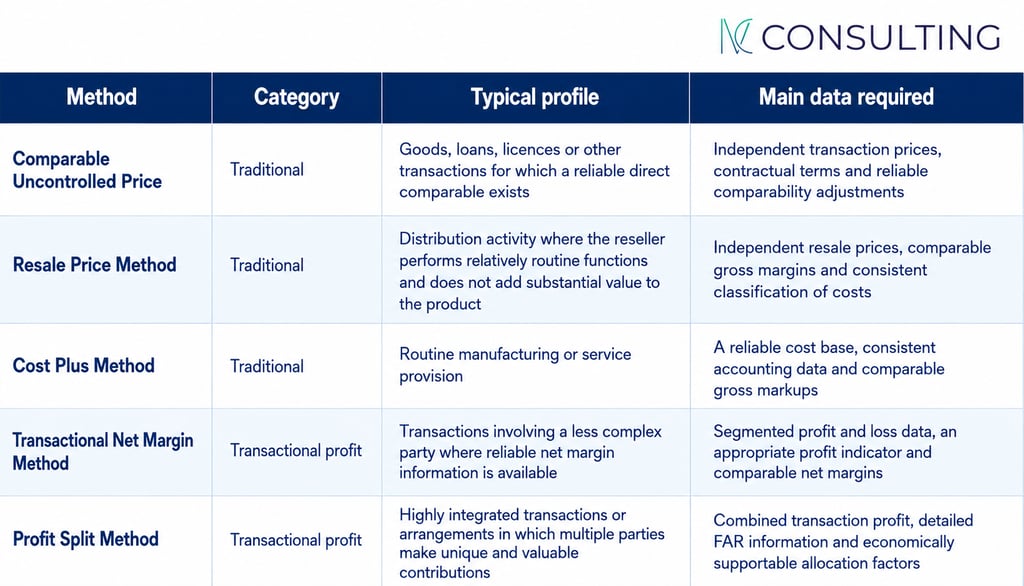
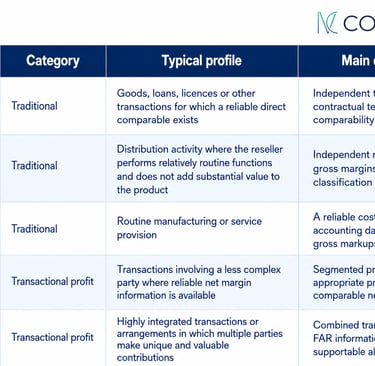
The table is a starting point, not a decision rule. For example, the absence of a direct comparable does not automatically justify a Profit Split Method. Similarly, TNMM should not be selected only because it is familiar or easier to apply.
What to review: Confirm that the method is applied to the correct transaction, uses consistent financial data and remains aligned with the group's current activities.
How Pillar Two's global minimum tax affects transfer pricing
The OECD Pillar Two Global Anti-Base Erosion rules introduce a 15% global minimum tax framework for large multinational groups, generally those with consolidated annual revenue of at least EUR 750 million.
Where the effective tax rate calculated for a jurisdiction falls below the minimum rate, the rules may impose additional top-up tax.
Pillar Two does not make transfer pricing less relevant.
Transfer pricing continues to determine how revenue, expenses and profit are allocated between legal entities. Those results can affect the financial accounting data, covered taxes and jurisdictional effective tax rates used for Pillar Two purposes.
In practical terms, a year-end transfer pricing adjustment may now affect more than a local corporate tax return. It may also affect tax provisions, Country-by-Country Reporting data, safe-harbor eligibility and Pillar Two calculations.
What changed in transfer pricing in 2026?
On 5 January 2026, the OECD released its Pillar Two Side-by-Side Package. Among other measures, the package:
introduced a permanent Simplified Effective Tax Rate Safe Harbour;
extended the Transitional CbCR Safe Harbour to fiscal years beginning on or before 31 December 2027, provided the relevant fiscal year ends no later than 30 June 2029; and
set a 17% transition rate for fiscal years beginning in 2026 and 2027.
A safe harbor is a simplified compliance route that can treat top-up tax as zero where specified conditions are met. The Simplified ETR Safe Harbour generally becomes available for fiscal years commencing on or after 31 December 2026, with optional earlier application from 31 December 2025 in certain circumstances. Its calculations rely primarily on data from the group's financial accounting systems.
The operational message is straightforward: transfer pricing, tax reporting and financial accounting data should no longer be managed as separate workstreams.
What to review: Reconcile transfer pricing calculations and true-ups with entity-level accounts, tax provisions, CbCR data and Pillar Two reporting inputs.
The three-tiered transfer pricing documentation structure
The OECD's standardized documentation approach has three components:
Master File: A high-level overview of the multinational group, its business operations, overall transfer pricing policies and global allocation of income and economic activity.
Local File: Detailed information about the local entity and its material related-party transactions, including the relevant analysis and method.
Country-by-Country Report: Aggregate information on revenue, profit, tax and indicators of economic activity across the jurisdictions in which the group operates.
Country-by-Country Reporting generally applies to groups with consolidated revenue of at least EUR 750 million. Master File and Local File thresholds, filing deadlines, formats and penalties are determined under domestic law and therefore vary between jurisdictions.
Documentation should not exist in isolation. It should reconcile with:
intercompany agreements;
invoices and calculations;
segmented financial results;
statutory accounts and tax returns;
the actual conduct of the entities; and
relevant regulatory filings.
A technically polished Local File will not resolve a contradiction between the documented policy and the way the group actually operates.
What to review: Test consistency across the Master File, Local Files, CbC Report, agreements, calculations and financial accounts.
Transfer pricing audits and Advance Pricing Agreements
Transfer pricing is a common source of international tax disputes because two jurisdictions may take different views of the same transaction.
For example, one tax authority may increase the taxable profit of a local entity without the counterparty jurisdiction automatically granting a corresponding reduction. This creates the risk of double taxation.
An Advance Pricing Agreement, or APA, is a prospective arrangement under which a taxpayer and one or more tax authorities agree how specified transfer pricing matters will be treated for a defined period.
Bilateral and multilateral APAs involve the affected tax authorities and can provide broader certainty for cross-border transactions than a unilateral arrangement. OECD materials describe APAs as an important dispute-prevention mechanism that provides tax certainty in advance for covered transactions.
An APA will not be proportionate for every business. It may be most relevant where transactions are material, recurring and complex, or where the potential consequences of inconsistent treatment are significant.
What to review: Consider whether major IP arrangements, financing transactions, restructurings or other high-value recurring flows justify an APA or another proactive dispute-prevention strategy.
How to Plan for Transfer Pricing?
Modern transfer pricing requires more than selecting a method and preparing documentation.
A defensible model normally requires alignment across five layers:
the business and value chain;
the functions, assets and risks;
the intercompany agreements;
the calculations and accounting entries; and
the supporting documentation.
When one layer changes, the others should be reassessed.
This is particularly important when a group enters new markets, reorganizes activities, introduces new financing, changes its intellectual property arrangements or prepares year-end transfer pricing adjustments.
The practical objective is not only to produce a compliant file. It is to establish a transfer pricing model that the business can operate, finance teams can calculate and tax teams can defend.
Is your current model aligned across policy, operations, documentation and Pillar Two?
Explore our transfer pricing documentation services or speak with our team about a FAR and Pillar Two readiness review.
2026 iValueChain Ltd
20 St Dunstan's Hill, London EC3R 8HL, United Kingdom | office@ivc-consulting.com | Privacy Policy | General Terms and Conditions